
Cranial Sacral Therapy Manual
This Cranial Sacral Therapy Manual page provides a comprehensive overview of the cranial-sacral system, anatomy, physiology, palpation concepts, rhythmic motion, and clinical application as presented in the Real Bodywork manual. The full printable manual is included for enrolled students in the
Cranial Sacral Therapy Online Course where this foundational content is paired with guided instruction and practice.
Contents
- History and Origins of Cranial-Sacral Work
- Cranial Anatomy and Sutures
- Cerebrospinal Fluid and Cranial Rhythm
- Core Principles of Cranial-Sacral Therapy
- Technique Concepts in the Manual
- Clinical Application and Session Flow
- Related Cranial Articles
- Glossary of Key Terms
- Accessing the Full Cranial Manual
History and Origins of Cranial-Sacral Work
Cranial-sacral therapy emerged from the early 20th-century osteopathic explorations of William Sutherland. Observing cranial sutures that appeared beveled for motion rather than immobile, Sutherland hypothesized that the cranium participated in a rhythmic mechanism analogous to respiration and circulatory motion. His lifelong experimentation and clinical observation established the foundational premise that cranial bones and membranous structures possess subtle mobility that can be palpated and influenced therapeutically.This insight revolutionized manual therapy by expanding the field beyond traditional musculoskeletal techniques to include an integrated view of the central nervous system, dura mater function, and fluid dynamics within the cranium and spine.
Cranial Anatomy and Sutures
The cranium consists of multiple bones that form a protective but adaptable housing for the brain. Central to craniosacral motion is the sphenoid — often described as a “keystone” because it articulates with most other cranial bones. Adjacent bones include the occiput, parietals, temporals, and frontal bone.
Cranial sutures are specialized joints that allow minute motion. Rather than fusing completely, these interdigitating sutures provide flexibility, helping dissipate forces and enabling dynamic interaction with the cerebrospinal fluid rhythm. This concept underlies the anatomical basis for palpation and therapeutic contact.
Cerebrospinal Fluid and Cranial Rhythm
Cerebrospinal fluid (CSF) is produced within the brain’s ventricles and circulates around the central nervous system in the subarachnoid space. Fluctuations in CSF pressure and circulation contribute to a subtle rhythmic motion of the craniosacral system, commonly referred to as the cranial rhythm.
This rhythmic expansion and contraction — described as flexion and extension — are detectable by trained palpation and serve as a central reference for evaluating restrictions, asymmetry, and tension in the cranial and dural membranes.
Core Principles of Cranial-Sacral Therapy
- Cranial rhythm is subtle, continuous, and functionally significant.
- Palpation is gentle and driven by tissue response, not force.
- Presence and sensitivity of the practitioner enhance therapeutic outcome.
- The dural membrane system transmits forces throughout the craniosacral system.
- Interconnectedness of the cranium, sacrum, and spinal dura underlies global motion patterns.
Technique Concepts in the Manual
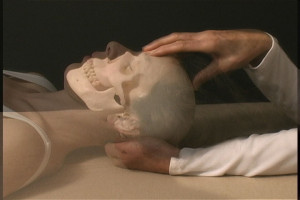
The manual organizes techniques conceptually rather than as strict protocols. Instruction includes palpation of the cranial rhythmic impulse, guiding contact points over the sphenoid, occiput, temporals, parietals, and associated membranous structures. Techniques emphasize establishing a still point, tracking rhythm changes, and supporting unwinding or release as detected through palpatory feedback.
Rather than imposing movement, practitioners are taught to respond to what the body reveals through tissue tension, rhythm amplitude, and membranous tension patterns.
Clinical Application and Session Flow
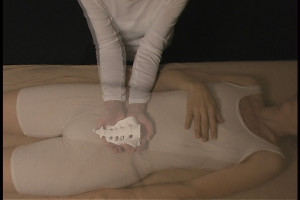
Cranial-sacral work is frequently integrated into a session by first establishing contact with the cranial rhythm and dural tube, then sequentially evaluating connections between the cranium, cervical region, sacrum, and dural membrane. Clinical emphasis is placed on listening through palpation, supporting fluid motion, and responding to changes in rhythm and symmetry. This approach is applicable across a range of conditions including chronic pain, headache disorders, neurological tension patterns, and restrictions associated with stress or trauma.
Knowledge Check
Clinical Signs and Movement Patterns
In practice, clinicians look not only for rhythm quality but also for the ways rhythm varies with postural shifts, respiration, and motion transitions. Patterns may include amplitude asymmetry, rhythm damping near restrictions, and aberrant pauses. Understanding typical deviation patterns helps practitioners differentiate tension related to trauma, systemic tension, or habitual postural compressions.


Related Cranial Articles and Resources
These companion resources expand the key ideas referenced in the cranial-sacral manual—how the work functions clinically, how the cranial rhythm is understood and assessed, and where cranial therapy is commonly applied.
-
How Does Cranial Sacral Therapy Work?
— Explains the central clinical idea behind cranial work: light, sustained contact supports self-regulation rather than mechanical correction, with emphasis on listening, timing, dural/fascial continuity, and stillness as the system reorganizes. -
What Conditions Is Cranial Sacral Therapy Used For?
— A clinical overview of common condition categories where cranial therapy is used to support regulation and adaptability (rather than “treating diagnoses”), including headaches, neck/jaw tension patterns, stress/anxiety dysregulation, chronic pain patterns, and sleep-related issues. -
What Is the Cranial Rhythm in Cranial Sacral Therapy?
— Defines the cranial rhythm in practical terms, distinguishes it from breath and pulse, and explains how practitioners assess rhythm quality (amplitude, symmetry, ease, continuity) as feedback during treatment. -
Cranial Sacral Therapy Knowledge Quiz
— A short 10-question quiz that checks understanding of foundational concepts (cranial rhythm, dural system, cranial bones, and nervous-system regulation) and reinforces the core learning points from the manual.
Course link: Cranial Sacral Therapy Online Course
— Includes the full printable manual and structured instruction.
Glossary of Key Terms
The following terms are used throughout cranial-sacral therapy and are referenced in the training manual and course material.
- Cranial Rhythm: A subtle, rhythmic expansion and contraction of the craniosacral system associated with cerebrospinal fluid production and reabsorption.
- Craniosacral System: The functional system formed by the cranium, spinal column, sacrum, cerebrospinal fluid, and the membranes that surround and support them.
- Cerebrospinal Fluid (CSF): A clear fluid that circulates within and around the brain and spinal cord, contributing to the cranial rhythmic impulse.
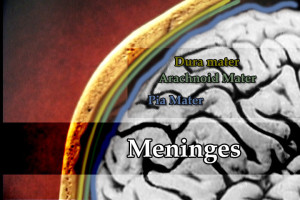
- Dura Mater: The tough outer meningeal membrane that surrounds the brain and spinal cord and transmits tension throughout the craniosacral system.
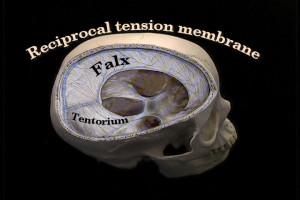
- Reciprocal Tension Membrane: The balanced functional relationship of the dural folds (falx and tentorium) that helps distribute forces within the cranium.
- Flexion and Extension: Descriptive terms used to explain cranial motion patterns as the craniosacral system expands and contracts.
- Fulcrum: A point of stillness or balance created by gentle practitioner contact around which the craniosacral system reorganizes.
- Still Point: A temporary pause in cranial rhythmic motion during which rebalancing of the system may occur.
- Unwinding: A spontaneous release pattern in which the body subtly moves as restrictions within the craniosacral system resolve.
- Palpation: The use of sensitive touch to perceive motion, rhythm, and tissue quality within the craniosacral system.
Accessing the Full Cranial Manual
This page provides an overview of core concepts from the Real Bodywork cranial-sacral therapy manual. The complete printable manual, along with structured lessons and guided instruction, is available to students enrolled in the
Cranial Sacral Therapy Online Course.